
Buying a Home on Well and Septic in King George County
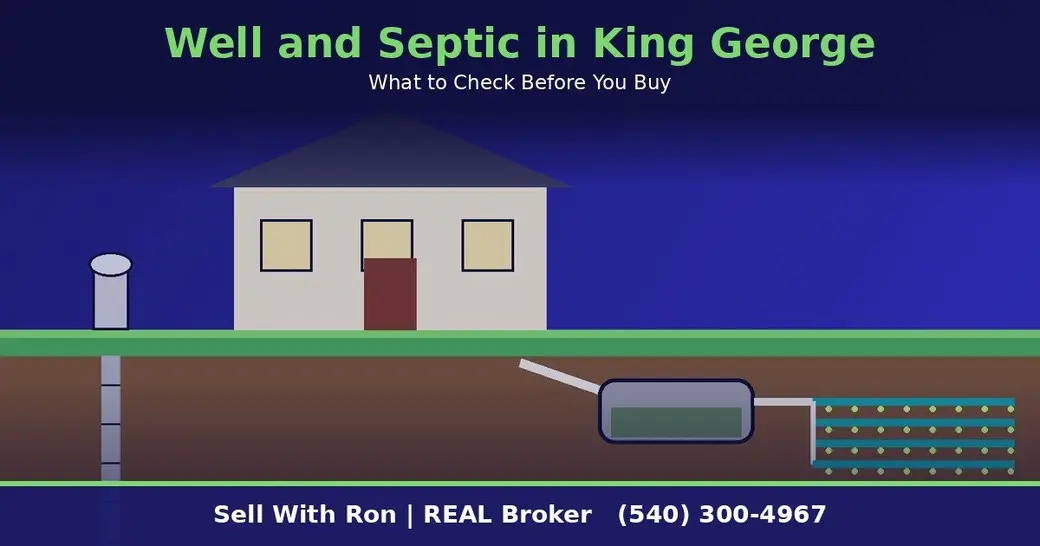
Quick answer: Before you buy a King George County home on a private well and septic, confirm it isn't on public utilities, pull the septic permit file from the local health department, schedule the septic inspection early and test the well water. King George also requires septic pump-outs every five years (King George County).
Whether you're looking along the Route 3 corridor toward Fredericksburg or near Dahlgren and Route 301, some King George listings will be on a private well and septic system instead of public utilities. That adds a few steps to your due diligence, and the earlier you take them, the less likely they are to hold up closing.
Step 1: Confirm how the home gets water and sewer
Public water and sewer in the county are run by the King George County Service Authority, which operates a wastewater treatment plant in each of its five service areas and 12 well-driven water systems (King George County). Its customer page tells you to search the address on the Service Authority System Web App to confirm whether a property is served by public water, wastewater or both (King George County).
Don't rely on the listing alone. Look the address up yourself. A home can have public water and a private septic system, or the reverse, and each one changes what you inspect.
Step 2: Pull the septic records from the health department
The Virginia Department of Health (VDH) says septic records are available on request from your local health department (VDH). In King George, that's the King George County Health Department and Environmental Services, part of the Rappahannock Area Health District, in the Village Center on Kings Highway (VDH Rappahannock).
Here's what to look for in the file (VDH):
- Construction permit. It describes the tank, any pump chamber and the drainfield, plus the design capacity in gallons per day. Residential systems are designed at 150 gallons per day per bedroom, so a three-bedroom design is 450 gallons per day (VDH).
- Operation permit. This is VDH's authority to use the system. It lists the permitted capacity and any ongoing requirements, such as annual operator inspections for alternative systems.
- Inspection reports and as-built drawing. These show changes from the original design and where the parts actually are, which helps when the tank has to be uncovered.
- Enforcement records. Check for any open Notice of Violation requiring repair of a failing system.
If you plan to add a bedroom, compare that plan against the permitted capacity before you make an offer.
Step 3: Check the deed for septic documents
VDH also recommends checking the deed search for conditional permits, waivers, easements and any notice of recordation for an alternative system (VDH). One detail matters a lot: under Va. Code Section 32.1-164.1:1, a waiver granted to repair a failing system is generally null and void when the property sells, while a waiver for a voluntary upgrade does not lapse at sale (VDH). Your title company can help you find recorded documents.
Step 4: Schedule the septic inspection early
VDH does not require a septic inspection before a property changes hands, but lenders may, and VDH recommends one by a licensed professional either way (VDH). Timing is the part buyers miss. VDH suggests inspecting several weeks before closing, because a major repair needs a design, a VDH construction permit, installation and a new operation permit, and that process can take weeks (VDH).
For a conventional system, an inspection may cover the septic tanks and distribution boxes plus a loading test, which VDH calls especially important when the home is vacant (VDH).
Step 5: Ask for the last pump-out record
All land in King George County is designated a Chesapeake Bay Preservation Area (King George County). The county says its code requires septic systems to be pumped out every five years, and residents verify it with a compliance form (King George County). VDH notes that pump-outs are required for conventional systems in the Bay Preservation Area (VDH).
The county estimates a typical pump-out at $300 to $700, compared with $3,000 to $15,000 to repair or replace a damaged system (King George County). Ask the seller for the most recent pump-out receipt and compliance record.
Step 6: Test the well water
VDH does not test private wells, and it doesn't require water testing for a home sale, though your lender may (VDH). VDH suggests buyers test for basic indicators (including arsenic, iron, lead, manganese and nitrate), bacteria (total coliform and E. coli) and radiological items (uranium, gross alpha and radon) (VDH). Use a lab accredited under Virginia's VELAP program.
Find out what kind of well it is. VDH describes bored wells as generally shallow, typically dug 45 to 70 feet deep, and more susceptible to surface contamination than drilled wells (VDH). King George lies east of I-95, the area VDH describes as the Coastal Plain, where wells draw from layered sediments (VDH).
Selling a home on well and septic? Gather the permits and pump-out records before you list. See how I sell homes or get a free home evaluation. Looking around the region? See my Fredericksburg area page and my Dahlgren area guide.
FAQ
Does Virginia require a septic inspection when you buy a house?
No. VDH does not require an inspection before a property transfer, but lenders may require one, and VDH recommends an inspection by a licensed professional even when it isn't required (VDH).
How often must a septic tank be pumped in King George County?
King George County says its code requires septic systems to be pumped out every five years, and owners confirm it by submitting the county's pump-out compliance form (King George County).
What should I test well water for when buying a home?
VDH suggests prospective buyers test for basic indicators, bacteria such as total coliform and E. coli, and radiological items including uranium, gross alpha and radon (VDH).
How can I tell if a King George home has public water or sewer?
Search the address on the King George County Service Authority System Web App, which the county's customer page points to for confirming public water and wastewater service (King George County).
Questions about a well and septic home?
Buying or selling in King George County? Call or text me at (540) 300-4967, and I'll help you line up the records and inspections before you sign.
Ron Chronister, REAL Broker
Categories
Recent Posts



GET MORE INFORMATION