
Buying New Construction in Spotsylvania: Contracts, Deposits and Walk-Throughs
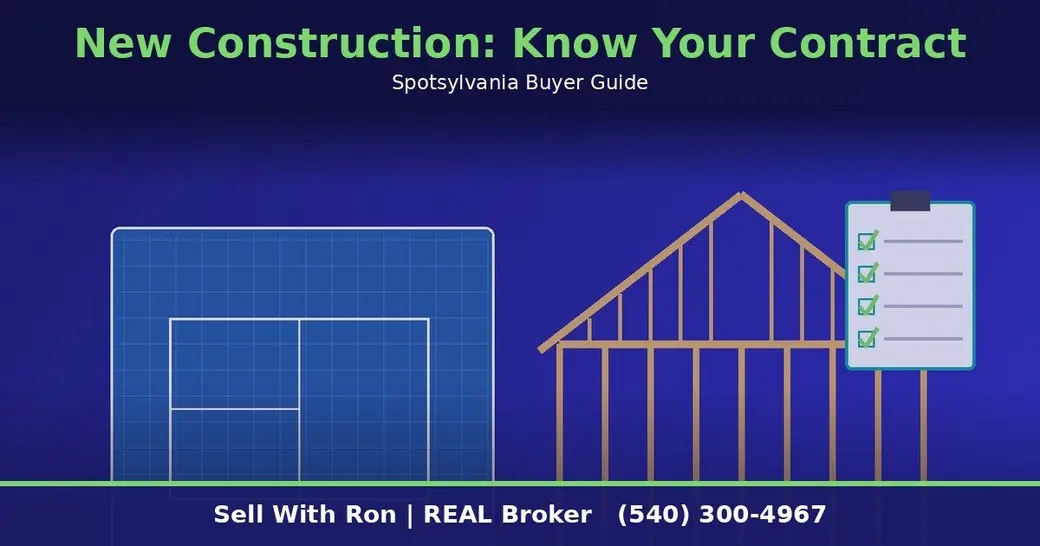
Quick answer: Buying new construction in Spotsylvania usually means signing the builder's own contract, so read the deposit, completion and warranty terms before you sign. Virginia law implies a one-year warranty on new homes and five years on the foundation (Code of Virginia § 55.1-357). Plan your own walk-throughs, and close only after the county issues a certificate of occupancy.
Whether you are touring model homes near Massaponax, along Courthouse Road (Route 208), off Route 3 and Plank Road, or out toward Lake Anna, the paperwork works the same way. Here is what to know before you sign.
The builder's contract is not a resale contract
When you buy a resale home, the contract is usually a standard form. Builders typically use their own agreement, written by their attorneys. Read it closely, and pay attention to:
- Completion date and delays. What happens if the home is late, and whether you have any remedy.
- Selections and change orders. Deadlines for choosing finishes, how upgrades are priced, and whether upgrade money is refundable.
- Financing. Whether you must use the builder's lender to get incentives, and what happens if your loan falls through.
- Warranty language. Watch for anything that waives or limits your warranty rights.
That last point matters. Virginia lets a contract waive or modify the implied new home warranties, or sell a home "as is," only if the waiver is conspicuous, in capital letters at least two points larger than the other type, and states exactly which warranties are waived (Code of Virginia § 55.1-357). If you see bold capitals in the warranty section, slow down and ask questions.
Deposits: who holds your money
The CFPB describes earnest money as a good-faith deposit held by the seller or a third party, like a real estate agent or title company. It is returned if the contract ends for a permissible reason, and it may be forfeited to the seller if the buyer does not perform (CFPB).
On new construction, ask three questions before you write the check:
- Who holds the deposit: the builder, or a title company in escrow?
- When, if ever, does it become non-refundable?
- Are upgrade or lot-premium payments treated differently from the main deposit?
Get the answers in the contract, not just from the sales office.
What the builder must disclose
Virginia's Residential Property Disclosure Act exempts the first sale of a dwelling, so you won't get the standard resale disclosure form. But the builder of a new dwelling must still disclose in writing all known material defects that would violate the building code (Code of Virginia § 55.1-702).
Timing depends on the build stage. For a completed home, that disclosure comes before the contract is ratified. For a home sold before or during construction, it comes after the certificate of occupancy is issued. If the builder knows of no defects, no written disclosure is required (Code of Virginia § 55.1-702).
County inspections and your walk-throughs
Spotsylvania requires a building permit to construct a home, and no building can be occupied until the Building Official issues a certificate of occupancy (Spotsylvania County). The county's inspection guide for new single-family homes runs from footings through framing, insulation and a final inspection, code 990, when the house is ready to occupy (Spotsylvania inspection guide).
Before the certificate of occupancy, the county also requires every inspection passed, third-party paperwork turned in, and a certified blower door and air leakage test (Spotsylvania inspection guide).
County inspections check code minimums. They are not a full review for you. The CFPB notes that buyers typically have the right to hire their own home inspector (CFPB). I recommend three walk-throughs:
- Pre-drywall. After framing and rough-ins, before the walls close. This is the only time to see wiring, plumbing and framing.
- Final walk-through. Before settlement, with your inspector and a roll of painter's tape. Put every item on a written punch list.
- Before the warranty ends. Walk the home again well before the first anniversary of closing.
Warranty claims after you move in
Under Virginia law, the implied warranty runs one year from the transfer of title or the date you take possession, whichever comes first, and five years for the foundation (Code of Virginia § 55.1-357).
To make a claim, you first send the builder written notice by certified mail, commercial overnight delivery, or hand delivery with a receipt. The builder then gets a reasonable time, not to exceed six months, to fix the defect (Code of Virginia § 55.1-357). Keep copies of everything.
Buying new while selling your current home
Builder timelines and your sale need to line up. Browse my Spotsylvania page, get a free home evaluation, and learn how I sell homes so the closing dates match. Buyers commuting on I-95 or into Fredericksburg should also time the drive from each community.
FAQ
How long is the new home warranty in Virginia?
Virginia's implied warranty lasts one year from title transfer or possession, whichever comes first, and five years for the foundation when the seller is in the business of building or selling homes (Code of Virginia § 55.1-357).
Do builders give a property disclosure statement?
Not the standard one. The first sale of a dwelling is exempt, but the builder must disclose in writing any known material defects that would violate the building code (Code of Virginia § 55.1-702).
When can I move into a new home in Spotsylvania?
Only after the certificate of occupancy is issued. Spotsylvania County says no building or structure can be occupied until the Building Official issues one (Spotsylvania County).
Should I get my own inspection on new construction?
Yes. County inspections check code requirements, and the CFPB notes buyers typically have the right to hire a home inspector to examine the home's structure and systems (CFPB).
Ready to look at new construction?
Thinking about a new build in Spotsylvania? Call or text me at (540) 300-4967 before you sign the builder's contract, and we'll go over the deposit, timeline and walk-through plan together.
Ron Chronister, REAL Broker
Categories
Recent Posts



GET MORE INFORMATION