
Home Inspection Tips for Stafford Buyers: What to Ask For and When
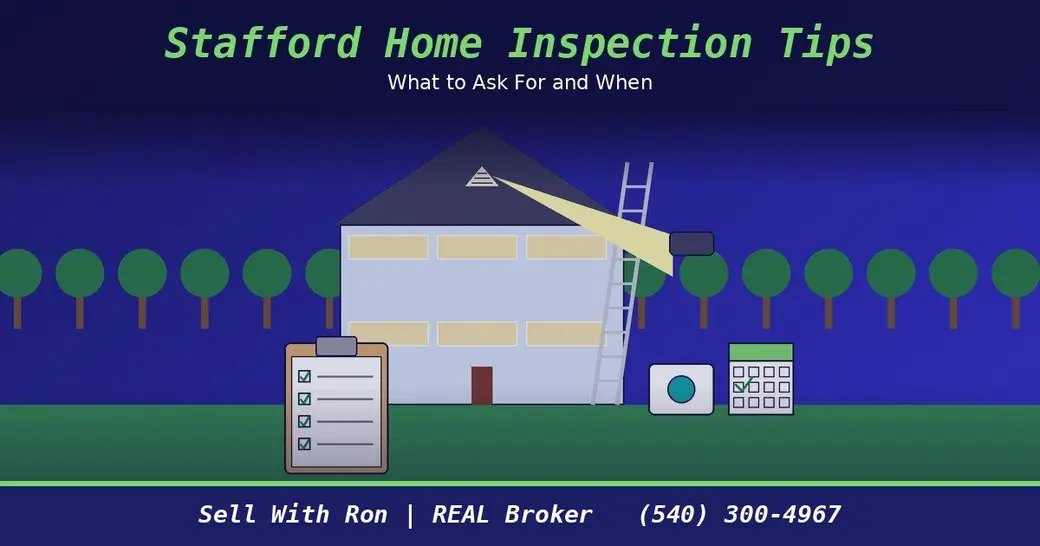
Quick answer: For a Stafford home purchase, hire a Virginia-licensed home inspector, write your inspection contingency with deadlines you can meet, and book the inspection as soon as the contract is ratified. A standard inspection is visual only. Ask separately for radon, wood-destroying insect, lead paint, and well or septic checks when they apply.
Whether you're touring a townhome off Garrisonville Road (Route 610), a newer build near Embrey Mill, an older house in Falmouth or a home off Route 1 near Aquia, the inspection is your best look at a home before you're committed. Here's how to set it up, and what to ask for, based on Virginia law and the two main national inspection standards.
What Virginia law says about inspections
Virginia's disclosure law is built around "buyer to beware." The state's residential property disclosure statement says the owner makes no representations about the property's condition. It advises buyers to do their own due diligence, including a home inspection, a mold check by a business that follows EPA guidelines and a residential building energy analysis, before settlement (Va. Code § 55.1-703).
Under Virginia law, a home inspection is done for pay by a licensed home inspector. It includes a written evaluation of the readily accessible parts of the home: heating, cooling, plumbing and electrical systems, structure, foundation, roof, masonry, and exterior and interior components (Va. Code § 54.1-500).
Hire a licensed inspector
The Board for Asbestos, Lead, and Home Inspectors at DPOR licenses Virginia home inspectors. Applicants must pass the National Home Inspector Examination, and licensees complete 16 contact hours of continuing education every two-year cycle (DPOR). Inspectors who hold the New Residential Structure (NRS) designation also complete a four-hour NRS course each cycle, which is worth asking about if you're buying new construction (DPOR).
Questions to ask before you book:
- What's your Virginia license number? Then confirm it on DPOR License Lookup.
- Which standard of practice do you follow?
- Can I see a sample report, and how soon will I get mine?
- Will you get on the roof and into the attic and crawl space, or tell me in writing why not?
- Do you offer radon or wood-destroying insect inspections, or should I hire someone else?
What a standard inspection doesn't cover
Both national standards say an inspection is not technically exhaustive. The ASHI standard covers readily accessible, visually observable systems. Its report flags items that aren't functioning properly, are significantly deficient or unsafe, or are near the end of their service lives (ASHI).
Under ASHI's standard, the inspector is NOT required to report concealed conditions, determine repair costs or code compliance, or check for wood-destroying organisms, mold or environmental hazards (ASHI). InterNACHI's standard similarly excludes radon, mold, lead paint and property boundary lines (InterNACHI). If you want those answers, you have to order them separately.
Add-on tests to consider
- Radon: EPA says to test no matter where you live. It recommends fixing a home at 4 pCi/L or higher and considering a fix between 2 and 4 pCi/L (EPA).
- Lead paint (homes built before 1978): Federal rules give buyers a 10-day period for a lead paint inspection or hazard evaluation. The parties can agree in writing to change it, or the buyer can waive it (EPA).
- Septic: VDH doesn't require anything when a septic property is sold, but the local health department keeps permits and records. The permit shows the system's design capacity, based on 150 gallons per day per bedroom (VDH).
- Private well: VDH doesn't test private wells. Testing is up to the owner, so build a water test into your contract if the home has one (VDH). My well and septic guide covers the details.
When to schedule, and what to ask for after
The Virginia REALTORS standard forms library includes a Home Inspection Contingency Addendum (Form 600D, current version dated July 2026) (Virginia REALTORS). Before you sign, go over every deadline in your contingency with your agent, and book the inspector as soon as the contract is ratified so the report arrives with time to spare.
When the report comes in, sort it into three groups: safety items and material defects, items that need a specialist's evaluation, and routine maintenance. Lead with the first two in your repair or credit request. A short, specific request usually lands better than a long list. My Stafford offer guide explains how inspection terms fit into a strong offer, and my VA loan guide explains how an inspection differs from an appraisal.
FAQ
Is a home inspection required to buy a house in Virginia?
No. Virginia's disclosure statement advises buyers to do their own due diligence, including a home inspection, before settlement, but whether you inspect and on what terms depends on your contract (Va. Code § 55.1-703).
Does a standard home inspection include radon or mold testing?
Not usually. The InterNACHI standard says an inspector isn't required to determine the presence of radon or mold, so ask for those tests separately if you want them (InterNACHI).
How do I check a Stafford home inspector's license?
Ask for the inspector's Virginia license number and look it up on DPOR's License Lookup. DPOR's Board for Asbestos, Lead, and Home Inspectors licenses home inspectors (DPOR).
What radon level should I worry about?
EPA recommends fixing a home if the radon level is 4 pCi/L or higher, and considering a fix if it's between 2 and 4 pCi/L (EPA).
Buying in Stafford?
I'll help you set inspection deadlines that work, line up the right add-on tests and negotiate what the report turns up. Browse my Stafford area page, or if you need to sell first, see how I sell homes. Call or text me at (540) 300-4967.
Ron Chronister, REAL Broker
Categories
Recent Posts
GET MORE INFORMATION