
Should You Sell As-Is in Fredericksburg? Pros, Cons and Disclosures
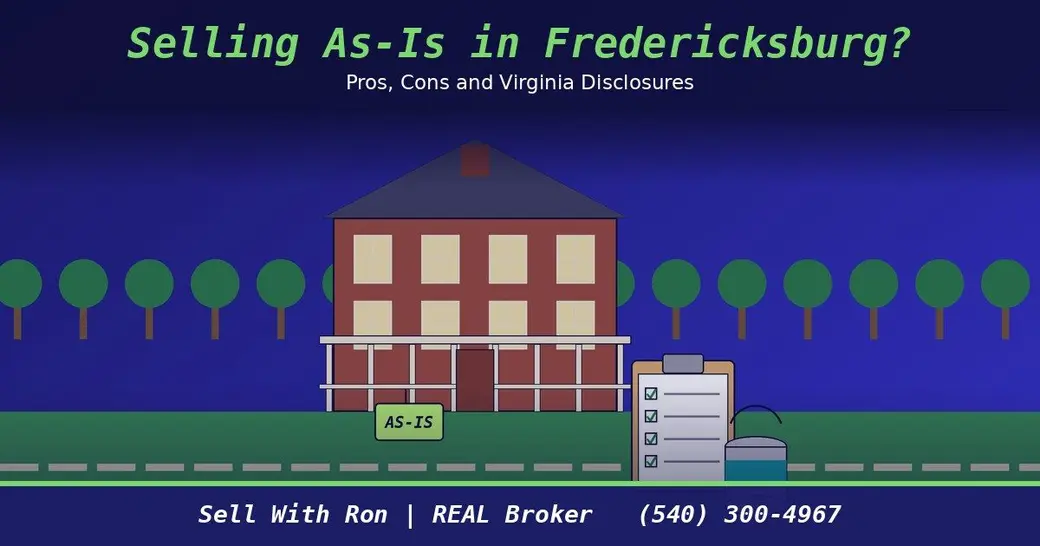
Quick answer: Yes, you can sell a Fredericksburg home as-is. But "as-is" only means you won't make repairs; it doesn't cancel Virginia's disclosure rules. You still give buyers the state's residential property disclosure statement, disclose certain known problems such as pending code violations, and follow the federal lead paint rule for most homes built before 1978 (EPA).
Selling as-is can be the right call when you're short on time or cash, handling an estate, or selling a house that needs more work than you want to take on. Here are the trade-offs and the paperwork, based on Virginia law and federal rules.
What "as-is" means in a Virginia sale
Virginia's disclosure law is built around "buyer to beware." The statement the owner furnishes says the owner makes no representations or warranties about the property's condition, and it advises buyers to do their own due diligence, including a home inspection, before settlement (Va. Code § 55.1-703).
So an as-is listing mostly sets expectations: you won't negotiate repairs. Buyers can still inspect. Whether they can walk away after the inspection depends on the contingencies in the contract you sign, so read those terms closely.
Pros of selling as-is
- Less work before you list. You skip lining up contractors, waiting on repairs and paying for them up front.
- Clear expectations. Buyers know from the start that repair requests are off the table, which can cut down on back-and-forth after inspections.
- Simpler for some estate sales. Transfers by a fiduciary in the course of administering a decedent's estate, guardianship, conservatorship or trust are exempt from the disclosure chapter, though other rules can still apply (Va. Code § 55.1-702).
Cons of selling as-is
- Buyers price in the unknowns. If they can't ask for repairs, many will adjust their offer to cover what they think the work will cost.
- The inspection still happens. An as-is label doesn't stop buyers from inspecting, and findings can still lead to renegotiation if the contract allows it.
- Some loans look closely at condition. Depending on the buyer's financing, the appraisal can flag issues that need attention before closing. My VA loan appraisal and inspection guide shows how that works on one common loan type.
- A smaller pool of buyers. Homes that need visible work tend to draw buyers who are comfortable with projects, which can narrow your options.
Disclosures you still owe
Selling as-is doesn't skip these. Virginia's Real Estate Board posts the current Residential Property Disclosure Statement, effective July 1, 2026, along with the other required forms (DPOR). Depending on what you actually know, you may also need to disclose:
- Pending code or zoning violations. If the locality has notified you in writing of a pending building code enforcement action or an unremedied zoning violation, you must disclose it (Va. Code § 55.1-706).
- A lis pendens. If you know one has been filed against the home, you must disclose it (Va. Code § 55.1-706.1).
- A private stormwater facility. If you know of one on the property, you must disclose its long-term maintenance and inspection requirements (Va. Code § 55.1-708.1).
- Repeated flood claims. If you know the home is a repetitive risk loss structure, meaning two or more National Flood Insurance Program claims of more than $1,000 were paid within any rolling 10-year period, you must disclose it (Va. Code § 55.1-708.2). If your home sits near the Rappahannock, ask your insurer about past claims.
Lead paint rules for older homes
If your home was built before 1978, whether it's a historic home downtown near Princess Anne Street or a mid-century rancher, this rule likely applies. For most housing built before 1978, federal law requires sellers to give buyers the EPA lead pamphlet, disclose known lead-based paint information and reports, include a Lead Warning Statement and give buyers a 10-day window to test, which the parties can change or the buyer can waive in writing. Sellers keep a signed copy for three years (EPA).
If your home is in the historic district, my historic district seller guide covers the review rules buyers will ask about.
Deliver disclosures before the contract is ratified
Timing matters. The owner must provide notice of the required disclosures before the purchase contract is ratified. If they're delivered after ratification, the buyer's remedy is to terminate the contract, generally within 3 days after in-person or electronic delivery or 5 days after the postmark if mailed. Settlement, occupancy, a loan application with the required notice or a separate written waiver can end that right sooner (Va. Code § 55.1-709).
Is as-is right for your Fredericksburg home?
Compare three paths before you decide: list as-is, fix only the items a buyer's inspector is sure to flag, or do a full pre-listing prep. Buyers shopping along I-95 and Route 3 often compare Fredericksburg homes with listings in Stafford and Spotsylvania, so your home's condition will be judged against theirs.
- See where prices stand in my City of Fredericksburg market report.
- Get a free home evaluation priced both ways, as-is and after repairs.
- Learn how I sell homes, or browse my Fredericksburg area page.
FAQ
Do I have to fill out a disclosure form if I sell as-is in Virginia?
Yes. Selling as-is doesn't exempt you. Unless your sale falls under an exemption in § 55.1-702, the owner furnishes the residential property disclosure statement provided on the Real Estate Board's website (Va. Code § 55.1-703).
Can a buyer still get a home inspection on an as-is house?
Yes. Virginia's disclosure statement itself advises buyers to get a home inspection before settlement. Whether they can cancel based on the results depends on the contingencies in your contract (Va. Code § 55.1-703).
What happens if I give the disclosures after the contract is signed?
The buyer can terminate, generally within 3 days after in-person or electronic delivery or 5 days after the postmark if mailed, unless settlement, occupancy, a qualifying loan application or a written waiver ends that right first (Va. Code § 55.1-709).
Does the lead paint disclosure apply to an as-is sale?
For most housing built before 1978, yes. The federal rule requires the EPA pamphlet, any known lead information, a Lead Warning Statement and a 10-day testing window that buyers may waive (EPA).
Thinking about selling as-is?
I'll walk through your home with you, price it as-is and after repairs, and make sure your disclosures go out on time. Call or text me at (540) 300-4967.
Ron Chronister, REAL Broker
Categories
Recent Posts
GET MORE INFORMATION