
Selling Rural Land or Acreage in Caroline County: What to Prepare
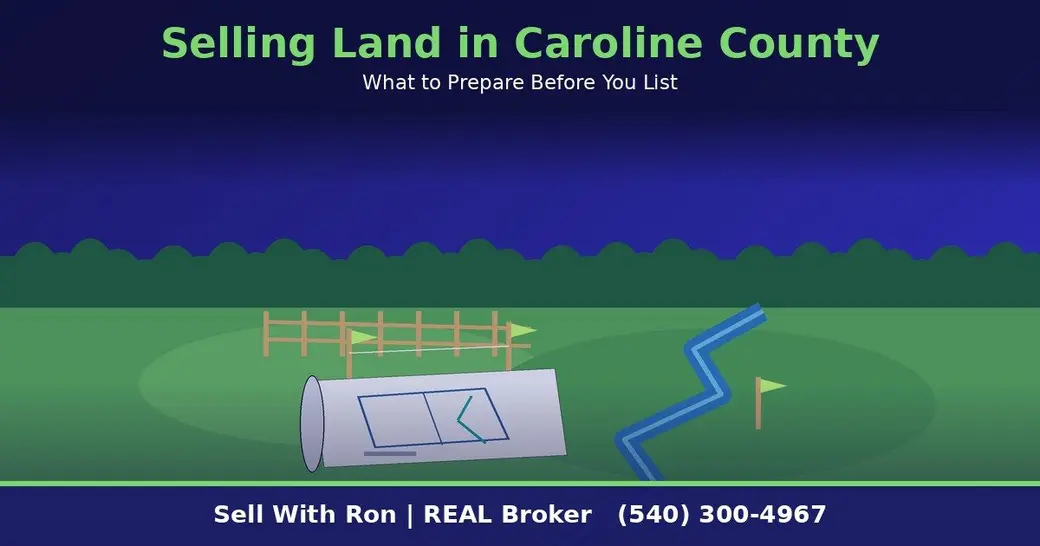
Quick answer: To sell rural land or acreage in Caroline County, start with what a buyer can legally do. Confirm the zoning district and its minimum lot size, which runs from 2 acres in RR-2 to 25 acres in AP. Then gather a survey, septic or well soil work, the flood map panel and stream buffers (Caroline County zoning).
Land buyers in Caroline County ask different questions than home buyers. Can I build? Can I split it? Will a septic system work? Is any of it in a floodplain? Whether your acreage is near Bowling Green, off Route 2 or Route 301, or close to I-95 around Ladysmith and Ruther Glen, the sellers who answer those questions up front get stronger offers. Here's the prep list I use.
1. Confirm the zoning and what it allows
Caroline County's zoning ordinance sets lot area, lot width and setbacks by district (Caroline County Zoning Ordinance). Rural parcels most often fall in the districts below, each allowing one dwelling unit per lot or parcel (Article XII):
| District | Minimum lot area | Minimum lot width | Front setback |
|---|---|---|---|
| AP (Agricultural Preservation) | 25 acres | 525 feet | 200 feet (Article XII) |
| RP (Rural Preservation) | 10 acres | 425 feet | 150 feet (Article XII) |
| RR-5 (Rural Residential) | 5 acres | 300 feet | 125 feet (Article XII) |
| RR-2 (Rural Residential) | 2 acres | 200 feet | 75 feet (Article XII) |
Those minimums tell a buyer right away whether a parcel can be divided. For example, a 30-acre tract in AP meets the 25-acre minimum once, while the same tract in RR-5 could, on paper, meet the 5-acre minimum more than once (Article XII). Width matters too. A parcel that has the acreage but not the frontage may not qualify.
Ask Caroline County's Planning and Community Development staff to confirm your parcel's district before you price it. The department's page links to the county GIS and its permit packets (Caroline County Planning).
2. Know whether the land can be subdivided
Dividing land runs through the county's subdivision ordinance. It covers the procedure for making and recording plats, general regulations, plat approval, exceptions and exemptions (Caroline County Subdivision Ordinance). If you or a buyer may want to split the tract, read the exemptions section and talk with planning staff early. Don't market lots you can't legally create.
3. Line up septic and well soil work
On land without public sewer, a buyer's first question is whether a septic system can be permitted. Since August 11, 2019, Virginia Department of Health applications for onsite sewage systems or private wells must include supporting work from a private-sector consultant licensed through DPOR, with narrow income and hardship exceptions (VDH). VDH also lists certification letters and subdivision reviews among the applications that need that private-sector work (VDH).
In plain terms, a licensed soil evaluator's report or a VDH-issued letter or permit on file gives a buyer real answers instead of a guess. If the parcel already has an old home site or system, request its records. VDH says septic records are available from your local health department (VDH). My well and septic buyer's guide shows what buyers will ask for.
4. Check flood maps and stream buffers
Caroline County posts its FEMA flood map panels by panel number on its flood map page. Find the panel that covers your parcel and note any flood zone so a buyer's lender isn't surprised later.
Streams matter too. Caroline County applies the Chesapeake Bay Preservation Act, whose Resource Protection Areas include a buffer at least 100 feet wide landward of wetlands and along both sides of any stream with perennial flow (Caroline County Environmental). Resource Management Areas include floodplains, highly erodible soils and steep slopes (Caroline County Environmental). If a creek runs toward the Rappahannock or Mattaponi through your land, the buildable area may be smaller than the acreage suggests.
5. Gather the paperwork buyers will ask for
- Survey or recorded plat. Shows boundaries, frontage and easements. If the last survey is old, consider a new one.
- Deed and access. Confirm road frontage or a recorded access easement. Landlocked parcels are hard to finance.
- Current use. List any farm, timber or hunting leases and when they end.
- Utilities. Note where power runs and whether internet service reaches the road.
- Photos and maps. Walk the boundaries, flag the corners and capture creeks, trails and clearings.
My Caroline County first-time buyer checklist shows the questions the buyer side brings. Answering them in the listing saves weeks.
FAQ
What is the minimum lot size for a house in Caroline County's rural districts?
It depends on the zoning district: 25 acres in AP, 10 acres in RP, 5 acres in RR-5 and 2 acres in RR-2, with one dwelling unit per lot or parcel (Article XII).
Do I need a perc test before selling land in Caroline County?
It isn't required to list, but buyers will ask. Since August 11, 2019, Virginia septic and well applications need supporting work from a DPOR-licensed private-sector consultant, so soil work on file helps (VDH).
How do I find out if my Caroline County land is in a flood zone?
Caroline County posts its FEMA flood map panels on its flood map page. Find the panel covering your parcel, and ask planning staff if the boundary isn't clear (Caroline County Flood Map).
Can a stream on my land limit where a buyer can build?
Yes. Resource Protection Areas include a buffer at least 100 feet wide along both sides of any stream with perennial flow, which can reduce the buildable area (Caroline County Environmental).
Selling land in Caroline County
Pricing acreage comes down to what it allows: zoning, frontage, soils and access. Start with a free evaluation, see how I market and sell property, or browse my Ruther Glen and Caroline County page.
Ready to talk about your land? Call or text me at (540) 300-4967, and I'll help you build the prep list for your parcel.
Ron Chronister, REAL Broker
Categories
Recent Posts
GET MORE INFORMATION